
MavenMagnet conducted a study in partnership with The Economic Times to evaluate the public performance of Indian government led by Prime Minister Narendra Modi. The study was published on May 14, 2016. Here’s the link to the study.

MavenMagnet conducted a study in partnership with The Economic Times to evaluate the public performance of Indian government led by Prime Minister Narendra Modi. The study was published on May 14, 2016. Here’s the link to the study.
Comments Off on ET Magazine – MavenMagnet research study: Second year of Modi Sarkar
Posted in General
There are lot of things that helps the business grow. One of those things, specially for a B2B business, is global expansion. Global expansion has become a necessity in lot of ways for service companies. All Fortune 100 companies are multinationals with operations across the globe. A cereal company sells cereal in US also sells cereal in Europe also sells cereal in India and China. So if they are looking for information like how they are doing competitively in the market or how their campaigns are doing, they will need measurement tools in every market. Therefore developing global capabilities is a slam dunk and in lot of ways a no-brainer.
Then why are many service companies regional? There are many benefits of being regional. You can develop niche expertise in a market and run the tables there. It’s easier to manage and contain, and if you are in a big market, there is way too much ground to cover in there than thinking of expanding wings across borders. But sometimes its prudent to have capabilities in multiple geographies to serve your consumers.
So you plan to go global. Let’s look into challenges that comes in your way. One of the key ones is resource management. The most fundamental resource is people. Getting the right people to work in the right market is the most essential thing. You should go to the markets that will provide you the best bang for the buck, but a key decision making factor, given most other things being equal, is also where you have the most dependable people to service the market.
We would all love to have presence in all 200 countries where Pepsi sells cola, but it is just not practical and in many ways not essential. Take a step at a time so that your operational capabilities are able to support your expansion. Operational capabilities expanding with your expansion is critical. Everything from language support to time zone support need to keep up the pace. There is no time of the day when you can allow downtime if sun is up in some part of the world where you are operating.
Go global if you it makes business sense. Go global at the right time in your growth curve. Go global if you have the muscle to sustain it.
Comments Off on Going global
Posted in General
We live in an irrational world. Everything from the stock market and consumer buying habits to people’s beliefs and their voting choice is irrational. As a marketer you have to navigate through this irrationality and fit your product in the mix. In other words, you have to accept the irrationality and make sense of it. And that’s where we come in picture.
At an individual level its complete chaos. Even looking at a few dozen maintains the chaos. The chaos normalizes when you take tens of thousands of consumers and their hundreds of thousands of conversations. What emerges out of this exercise is something really beautiful. You get strong patterns that define your consumers, what matters to them and influences them to make decisions in their lives.
The basic idea is to understand your consumers. Develop products that they want. Speak to them in the language they speak. That’s how you will decode the irrationality and become a part of their world.
Comments Off on The irrationality
Posted in Business, Technology
MavenMagnet conducted a study in partnership with The Economic Times published on February 27, 2016. Here’s the link to the study.

Comments Off on Expectations from Indian Union Budget 2016
Posted in Business, Technology
I recently spent a lot of time in an airplane coast to coast. While typically it is a great way for me to catch-up on my sleep, this trip happened to be a day time thing and I was not very sleepy. So while counting hours to land and thinking of better ways to convince prospective clients to use MavenMagnet services, I realized how being in this box makes doing research outside the box (read use MavenMagnet) such a no-brainer.
Before I talk about the parallels, let’s set the landscape. Day trip flying for 4 hours, no entertainment set in the plane and no wi-fi. So what did this lead to? About 150 people in the plane with nothing to do but either sleep or read or talk. So while having a light conversation with a good looking girl sitting next to me, I was listening to people sitting around me. People were talking about everything from who will be the next president to what they will do if Donald Trump become the President to when will Apple have a new product that is not just a newer version of iPhone or iPad to why season one of House of Cards was so much better than season two.
This was nothing but a minuscule of what conversations on the Internet are and what MavenMagnet scrapes to do market research. No one was asking anyone to talk about a specific thing. The conversation on next president was triggered by a Time magazine cover. The Trump comment was courtesy of the last night Republican primary debate and polls following that. The Apple conversation was triggered by Apple stocks falling down. House of Cards came up as one of many TV shows as a reaction to Golden Globe nominees list.
The Internet is this times millions. People talking among themselves. People talking with people they probably don’t know but have common interests. The kind of insights you can get out of scraping human conversation in an unbiased and unobtrusive way has no parallel out there. What we have developed at MavenMagnet is a set of tools and techniques to parse, dissect and understand these conversations, products in these conversations and people having these conversations. Market research cannot get better than this!
Comments Off on A lot of time in air
Posted in Business, Technology

Here’s a link to the story: http://www.mavenmagnet.com/Articles/MAVENMAGNET_ET_OldSchool_vs_NewAge.pdf
Comments Off on An ET Magazine-MavenMagnet study delves into how startup CEOs, the rockstars of today, stack up against their traditional counterparts in India
Posted in Business
I am a big believer of people being honest, truthful and good in general. But we humans also have a tendency to live in denial. To fix this and keep you on the way to success, what you need is something to measure your performance and optimize it.
Where I am going with this? I had a long pitch the other day, to convince a client to use MavenMagnet to evaluate their campaign performance. The argument client had was that our advertiser, who is running the campaign, is reporting on how well the campaign is doing, so why use MavenMagnet?
So here’s the scenario: An agency that developed your campaign and bought media for your campaign would also do reporting on how the campaign is doing. I was perplexed on why we even had to convince that you need an unbiased service provider, whose expertise is to evaluate campaigns, do the evaluation for you. Why burden the advertising agency, whose expertise is to run the campaign, with evaluating it and maybe fall in the trap of self denial? (Update: We were able to make the case using the superior and cutting-edge features of our product and got support from the advertising, media and PR agency for that).
MavenMagnet campaign evaluation product is the best service out there to measure your campaign on a competitive scale using years of benchmarks. Advertising agencies do a great job using the feedback from this campaign evaluation and course correct to improve the impact of the campaign. The idea is simple and win-win for all: let us partner with you to evaluate your campaign and provide you the analysis of what’s working, what’s not working and recommendations on optimization based on our expertise. Use the evaluation and optimize the campaign and be successful!
Comments Off on Critical Evaluation
Posted in Advertising, Technology
Most successful products address a problem. Sometime to the problem they are addressing is apparent, other times they are subtle, and a few times it’s not clearly realized by the consumers till they see the solution. The solution is more compelling when the innovation and the presentation makes it interesting.
First one that comes to mind is TED (the “original” one. The way this brand is diluted is the subject for some other post). People like good presentations and talks but the length of these talks is the biggest cause of displeasure for the audience. TED came up with a interesting solution. Power-packed talks ranging from 5 minutes to 20 minutes with all you need to know.
There is no problem that can be solved with something interesting. Good solutions can make seemingly uninteresting things interesting. Whether it’s hauling a cab (Uber) or renting your spare room (Air BNB) or lengthy surveys and boring focus group with conversation-based research (MavenMagnet), the idea is to identify the problem and come up with a solution that hits the nail on the head.
Comments Off on Make it interesting while solving a problem
Posted in Business
Article as published in The Economic Times.
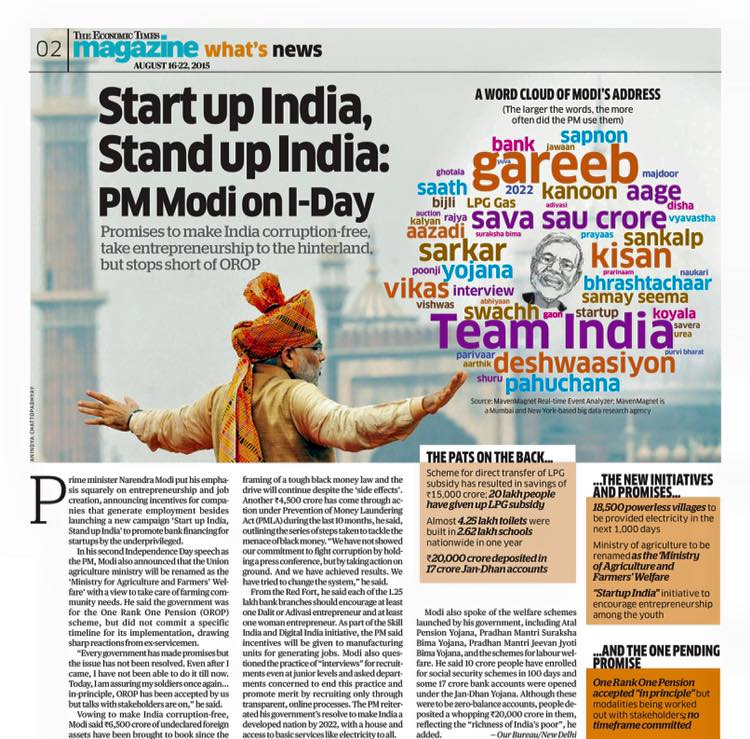
Comments Off on MavenMagnet Real-time Event Analyzer analyzes Modi’s independent day address
Posted in Business, Technology
Standards is another great way to create a foundation for something that is sustainable and dependable. In simple words, standards is something that can provide a universal way to understand, measure or use something. Standards have been around for ever. Currency is a standard for doing monetary transactions, kilogram is a standard for measuring weight and meter is a standard for measuring distance. In technology industry, standards are basically Key Performance Indicators or KPI. The popular ones are Google page rank to measure the popularity of a website or Nielsen TV rating to measure the success of a TV show (or MavenMagnet Magnet Score to measure the impact of the elements of your campaign).
The most fundamental element of standards is trust. The way you are measuring something should be fair for mass adoption. Just like it takes a while to build trust, it takes a while for a measurement to become a standard. Another key property of standards is that it should be easy to understand, test and use. The way you calculate the KPI can be as sophisticated as you want, but it should be transparent enough to test and easy enough to report.
Like platforms, standards depend on adoption. The success and failure of standards is dependent on how widely it is adopted. For good or for bad, displacing a well established standard is as hard as anything can be creating yet another competitive advantage for the business and a great barrier to entry in the market.
Comments Off on Platform and Standards: Part 2
Posted in Business, Technology
 Adscovery