The Swiss Knife Concept

Product designing is one of the most challenging and interesting jobs in any industry. A good product design is something that can provide a great competitive edge to any company. I think there is no golden formula that can define a good product design, but by analysing some successful products, which have good designs, we can find some characterstics of a good design. One such characterstic is to cover all the features of a product under the wrapper of simplicity and provide pivot points to access these features. This is what I call the Swiss Knife Concept of product designing.

Swiss Army Knife, or the “Offiziersmesser” (original name), has a really great product design of its own. The way a small pocket device, that looks like a knife handle, contains half a dozen tools hidden in it is really fascinating. The adoption of this product from Swiss Army and its enormous success speaks great volume about what a consumer is looking for in a product. I think the basic design principle here is to have one really transperent product feature for which the product is primarily known (in this case, a blade) and along with that have lots of other useful features. Then provide the product a real simple user interface and make it easy for the customer to access each feature individually.

Now let’s see how this very concept of product design is consiously or unconsiously adopted outside the World of this pocket device. Search giant Google seems to be built on the Swiss Knife concept. The most transperent feature being search and this surrounded by a few dozen other products is what defines this multi-billion dollar company. The simplicity with which Google has created its primary user interface with a search bar and “pivots” to reach to other products makes the product design as closely related to a Swiss Knife as it could be.

Another place where you can see this concept is in the SmartPhones. The basic feature of these mobile devices, for most of its customers, is to use it as a phone. But along with that there are a lot of other features that almost make the phone as feature rich as a personal computer. These features are discoverable by its customers using the software interface which provide options to the customers to reach to each one of these individual features. Apple iPhones took this even a step further. The iPhone includes iPod music player as an additional feature on the phone, and as the iPhone ads puts it so beautifully, its (Internet, music player and what not), on your phone.

Microsoft Word is a Swiss Knife of its own. Microsoft Word, that looks like a real simple word processor, has a lot of really useful features in it. Same is true with other products in the Office Suite. Normally, 80% of the customers end up using only 20% of these features. In order to ease the discovery of the zillion features that are there in Word and other Office products, The Office 2007 product suite has a ribbon at the top instead of the normal menu list. Word has always consisted many features, or what we can say is it was always a Swiss Knife, what this ribbon has done is added those much required more visible pivot points to make discovery and use of these features easier.

Of course you can not apply this concept to all the products out there. So how can we find out whether a product is right for Swiss Knife Concept? I think this can be done by analysing some things about the product like its primary feature, how its secondary features complement the primary feature, what problem is the product trying to address for its customers and how it is doing so. So if a product is having lots of complementary features, along with the main product feature which is essential for the product to exist, and all these compementary features should be there for the customers to access on demand, Swiss Knife Concept can be worth exploring for the product designers.

Basic thing here is to make the use of a product easy for the customers. How the Swiss Knife Concept does it is by providing customers with a real user friendly interface, which makes the adoption of the product seamless, and along with that provide other features that are easy to discover and use. Swiss Knife Concept gives the unique ability to a product designer to have lot of features in the product without taking away the similicity element out of it.

Advertising Customer Service

Customers are always looking for differentiating factors between different products and services available in the market. In many industries today, like insurance, car rentals and personal computers, the products are getting more and more standardized. They have the same look and feel, similar terms and conditions and in most cases, the same price tag. In such industries, to locate a differentiating factor is very difficult. Some factors which were previously not taken that seriously can now play a more important role in affecting the customers’ buying decision. One of such factors is customer service.

Customer service has always been a very important factor to ensure long term success in any industry. But normally, customer service is something that comes under the radar when something goes wrong with the product, or in other words, after the product is already bought. We can draw an interesting parallel between customer service and product design. When the design of something is not upto the mark, it is noticed, but when the design is good, it is taken to be as expected and goes unnoticed. Similarly, if the customer service is bad, people notice it and talk about it, but if it is good, it is taken to be granted. It is the job of the company to expose this good customer service and make sure people consider it before making a buying decision. 

There are several ways to expose customer service. With the growing interaction between customers and companies through new mediums like blogs, newsgroups and message boards, it is becoming easier then ever to expose customer service. Another very effective way to expose customer service is through advertisements. It’s true that many companies advertise in order to create brand awareness, but along with that, advertisements should also be used to highlight factors that may be able to influence the customers. Something that the customer can remember when making a buying decision. Something that can put your product above the competing products. If your company has the customer service that can play this crucial role, make sure you bring it up in your advertisements.

One company that does a stellar job in advertising customer service is Avis. Avis has designed everything from its tagline (We try harder) to television commercials around its customer service. The car rental company tries to make sure that they communicate to the customers that it will put extra effort to provide the best customer service. Another company that falls under this league is Dell Computers. Customer Service at Dell is exposed right from the moment the customer thinks of buying a computer. Dell makes sure they communicate to the customer that the computer they make is made just for you. Dell commercials and the company blog does an excellent job in to expose both their pre-purchase as well as post-purchase customer service to the customers.

The unique thing to notice about these companies is that they are highly customer focused and they make sure the customer realizes that. They have great customer service divisions and they make sure that the customer takes customer service into account while making the buying decision. No matter which industry your company falls under, you should put in great effort to join this league by following these two steps – first, provide great customer service to your customers, and second, advertise customer service, make sure you communicate to the customer that customer service is an important thing and you are the best option available out there.

iPhone – iPod way or Mac route?

Apple released its much awaited iPhone on June 29th. The wait, the hype and the buzz around the product was expected, but still it’s really hard to believe the overnight queues outside the AT&T and Apple showrooms on June 29th. People waited hours in the queue to buy a mobile phone. In the industry where the service providers give away the phone for free, or sometimes even with cash back, people are eager to buy a $500 iPhone. Well they are the loyal Apple early adopters, but the million dollar question is: will iPhone do an iPod or will it go down the memory lane like the Macintosh?

iPhone is a very closely protected product like Macintosh was in the early 80s. Steve Jobs is well known for controlling the end-to-end development of his products. (If Apple had the strength of laying down their own cellphone network, it would not have surprised me if they went for that.) So in order to control its product closely Apple released the product only with At&T as the sole service provider. This is not the only tight coupling in iPhone. Apple has its Mac OS on the iPhone, and through it Apple controls what software can run on the phone and what cannot. Like Apple has put Google products like Maps and YouTube on the phone. In short, Apple is doing the same thing that they did with the Mac, creating a closed ecosystem for its product. This makes me wonder if this is a call to a Microsoft to come up with a more open ecosystem and concur the World?

iPhone is a design genius just like iPod. Each reviewer who reviewed iPhone gave great reviews. Walter Mossberg of WSJ and Steven Levy of Newsweek describe iPhone to be revolutionary and the best product in its class that lives up to the expectation. People admire the design work of Apple. iPod is the most sold personal music player in the World.  So just like Apple took over the personal music player market from Sony and others, there is no denying of the possibility of them doing the same with the iPhone.

iPhone does differ from iPod in some significant ways. The release of iPod was a modest release. The expectations were limited and there was no hype. And as expected, the big players in the personal music player market did not take it that seriously. But in case of iPhone, the case is different. Steve Jobs has become a design icon with each successful release of iPod and the expectations here were set as high as possibly can. And of course, all the major players in the mobile phone as well as other related business are on high alert to take on the iPhone. As per the early reviews, iPhone meets or beats the high bar set by Apple for Apple. Another significant difference is the product dependency. Apple went all alone with the iPod with its own software, music store and the hardware. But in case of iPhone, if they want a similar global reach, they will have to do partnerships with service providers around the World (which Apple is known for not liking that much).

iPhone release has stricking similarities with both iPod and Macintosh. iPhone is sure to change the entire dynamics of the cell phone device business. I think they also got the price equation pretty correct (people who are willing to buy iPods for $300, will happily pay $100 or $200 extra to get the best phone in the market, which is also an iPod). Within a few years, Apple will have a whole range of iPhones in the market with different functionalities and price tags to meet the needs of different customer segments. The thing to watch for is the partnership strategy of the company. Will the company learn from its past and go for a better approach to be more open for partnerships or will the competition come up with better strategic positioning and send iPhone the Mac route? But if they get this one aspect right this time, there is no denying that iPhone is going to rock the World the iPod way!

Techno-centric or Customer-centric

The rate of failure for high-tech products is remarkably high. For every Facebook or YouTube, there are thousands of start-ups that have failed. Why? Were their products technologically inferior? Most of the time, no. They fail because they are more focused towards the technology they are trying to develop than the reason for which they are developing the technology. They are, what we can call, techno-centric companies.

Techno-centric high-tech companies are the ones that think of technology as the center of their universe. They focus on technological innovation in product development without considering the potential customers of their product. The strategy adopted by these companies is to let the engineers and designers come up with the product and then sell the product to the potential customers. But this approach has a major flaw. People are always a bit reluctant towards adapting new technology. In general, masses do not accept new technology unless it is absolutely required to solve some problem they are facing. Of course, there will be early adopters who like to be at the cutting edge of technology who will readily go for the innovation, but in general, the common person will not go out and buy an expensive gadget if it is not absolutely essential. This makes it harder to cross the chasm, making it even harder for the products to become mainstream.

On the other end of the spectrum are the companies that do product innovation focusing on the needs of the customer. These customer-centric companies identify the problems faced by the customer and then develop solutions for these problems using technological innovation. The basic difference here is that the product or the service which is delivered is addressing a need of the customer, making it comparitively easier for the product to get mass adoption. By being customer-centric, it also becomes easier for the companies to develop the complete solution, because the basic reason for development is solving the problem.

Of course, there are exceptions where companies have hit the jackpot by just concentrating on the technology and then marketing the product to the customer. This can be attributed to the right timing of these companies, the massive backing of the early adopters, or coincidence of the technological innovation addressing an important problem faced by the customer. But I think the probability of this happening is too low for anyone to bet their company’s future on it (unless you are one of the blue-chip companies with deep pockets and great R&D budget).

It is also important to make sure we understand that just by being customer-centric, the company will not attain the ultimate success. You will always find products which are developed focussing on customer requirements but are not very successful. Customer-centric innovation is just a piece, a really big piece, of the puzzle. Along with this, you need to get a lot of other things correct to make your product a real success. Some of the important ones are good marketing set-up, ease of adoption, competitive pricing stategy and great customer service.

Ted Levitt, author of the Marketing Imagination, once wrote, “When people buy quarter-inch drill bits, it’s not because they want the bits themselves…they want quarter-inch holes.” This summarizes the high-tech marketing success mantra in very simple words. To be successful in high-tech marketing, you need to identify what your customers want, or what problems they are trying to fix, use technology to address those problems and then make sure you market the solutions to the problems. That’s customer-centric techno-powered innovation bound to sell!

Why pay the premium?

Starbucks, iPod and BMW – what is the one thing common in these three brands? Each one of them command a premium over similar products of other brands. It is amazing to see how the customer who creeps so much in filling gas at $4 per gallon, feels so good buying a grande (about 350 ml) latte from Starbucks for the the same price, even when the same coffee at other places is available for much less. Similar comparisons can be drawn for other products varying from a music player (iPod) to a pair of running shoes (Nike) to a car (BMW) to almost anything else.

There are a few things that help companies sell their products for a premium price. First and the most important one is the ecosystem. These brands create a unique ecosystem of some kind of sophestication around them. iPod, for example, creates an urbane and hip ecosystem around itself. iPod advertisements and Apple outlets lays the foundation for this ecosystem. Then every famous personality owning one makes it even more of a premium product. Talk show hosts ask the guests – “what songs do you carry on your iPod?” (instead of “what songs do you like to listen?”). iPod becoming a fashion symbol or more of a necessity adds to this ecosystem. The last leg of the ecosystem is the iTunes software and the whole array of accessories that go with the iPod. A customer can buy special speakers for their iPod, get docking stations, covers and what not. This ecosystem provides a lot of value to the product and helps the company earn a premium. 

A very important thing to note about the premium branded products is their superior quality. Many times we forget talking about this aspect of the products delivered by the premium brands and just focus on the marketing strength of the companies. The premium branded products are most of the time better when compared to the nearest competitor.

Emotional factor also plays a major role in paying the premium. The customers actually pay the premium to treat themselves. Buying these branded products give them satisfaction and help generate a good feeling about themselves. Take car for example. A customer pays a good amount to buy a BMW. Yes it is one of the best cars available out there, but how important is that while making a buying decision? The most important factor that kicks in here is the emotional feeling of the customer for the car. Some people have it in the list of their “things to buy when they can”. Others use it as a factor to satisfy themselves of attaining a certain level of success in life and yet others just buy it to treat themselves luxuriously (and assemble speeding tickets ;)).

Now let’s talk about how some companies are able to put their brands at that level which makes them important for the customers to have even at a premium. To answer this in a couple of words- Expressive Branding. This gives the customers a very straightforward way of making a statement about themselves. Each of these premium branded products have a certain level of luxury attached with them. And believe it or not, every common person loves luxury. People are obsessed by trading up. They will go to a coffee shop and ask for a cup of something which is not less then a tongue-twister for trading up. These brands promote themselves as a channel that people can use to trade up or to make a statement about themselves.

But it is not a bed of roses. When a company does expressive branding, it takes some major risks. When the brand plays the role of creating an identity statement for the customer, it always runs into the risk of a certain segment of people hating it. You will always find people who would never ever buy a certain brand because it’s not their type. The companies going for expressive branding make a very clear statement to the World – love us or hate us, but don’t ignore us. After all, if you want to earn a premium, you have to pay a price for it!

Customer segmentation – it’s all about the connection!

Customer segmentation is no longer a good to have feature. With more and more companies using customer segmentation as the base of their marketing and advertising efforts, it is something that is required for success in any industry. Effective use of customer segmentation will no longer give you a competitive edge, but in-fact it has become a feature that will keep your company competitive in the market. So what is the use of customer segmentation? You can find good amount of literature on this topic, but to sum it all up in a few of words – effective customer connection.

Online stores like Amazon and retailers like Best Buy have done great work in this area. Amazon pioneered the space with customized recommendations for the customers and a personalized home page. Best Buy’s application of customer segmentation in the brick-and-mortar World is very impressive. They remodelled their specific sections and at some places entire stores based on the segmentation data, trained their store associates accordingly and sent out coupons and set discounts based on this data. Best Buy now has radically different strategies to target different segments from young professionals to soccer moms.

To put it in very simple words, what these companies are doing is trying to get their customer what they think the customer is interested in. To lay parallels with an everyday example, you go to your favorite deli or coffee shop around the corner and the person attending you comes and asks – “the regular?” and (most of the time, if you are not in mood for the complete opposite or something else,) you say yes! That’s customer connection in its purest form. But if your business is not the deli or coffee shop where you can remember all the customers, with the help of computing power and analytical software, you can very well “remember and recall” what the customer is looking for and connect to the customer in a proactive way.

Another way customer connection can be enhanced is by proposing the customers what meets their requirement based on what features they used or products they purchased in the past. This can be done using the techniques of inference. Going back to our analogy of the deli, you order a specific sandwich most of the time, and the deli just came up with something that goes well with that sandwich or is a new sandwich similar to your favorite one, the person attending you can suggest it to you and most of the time you might go for it. Customers love suggestions or recommendations when they are sensible and unobtrusive. By forming segments, it can be inferred what the customers in this virtual segment will be interested in and can be served accordingly.

So let’s look into the specific contribution of segmentation over here. I think segmentation provides a couple of very important handles in the entire concept of customer connection. It helps companies deal with large number of customers. Most of the times it is practically impossible to connect to each customer one-on-one. So in order to give a close to one-on-one experience, the marketers can segment customers into buckets and connect with a segment of customers in the same way. Another benefit of segmentation is adding relevancy. By reviewing the activity of customers in a segment, a pattern can be derived and used to target that particular type of customer. The basic concept is to add relevancy to what customer is looking for, whether it is in form of showing relevant advertisements, promoting products or providing relevant content. By adding relevancy to the advertisements, they are not obstructive, but in-fact informative. Same is true for product promotion. If the product you are promoting is useful to the customer, it is not hard-selling, it is being helpful to the customer.

To sum it all up, segmentation basically provides the touch of practicality to the entire process of customer connection. In today’s World, where customers have lots of options and their time is more valuable than ever, proper customer connection is becoming a required feature. And to scale this to millions of customers in this global economy, customer segmentation is nothing but an essential tool.

Applemania

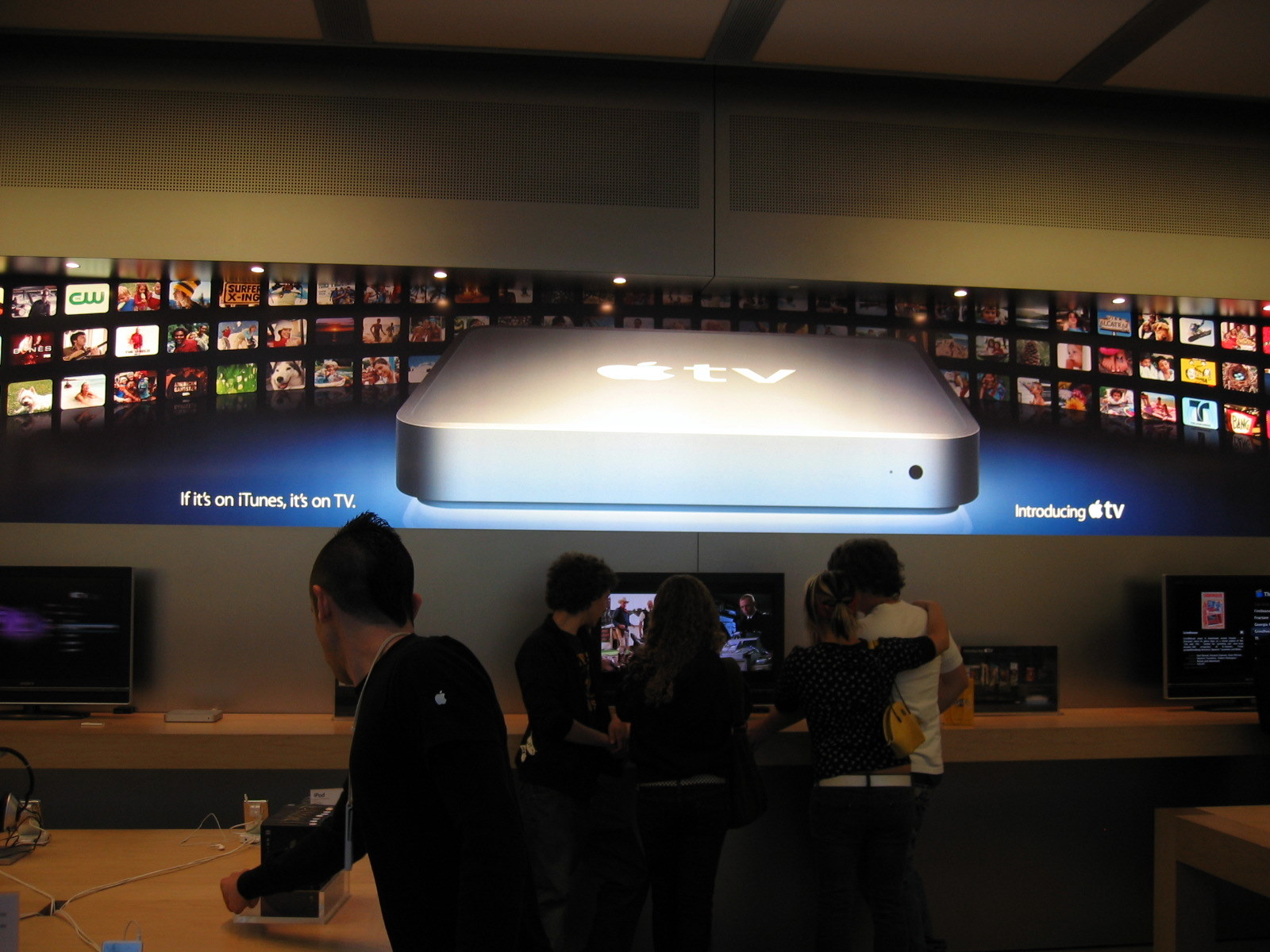
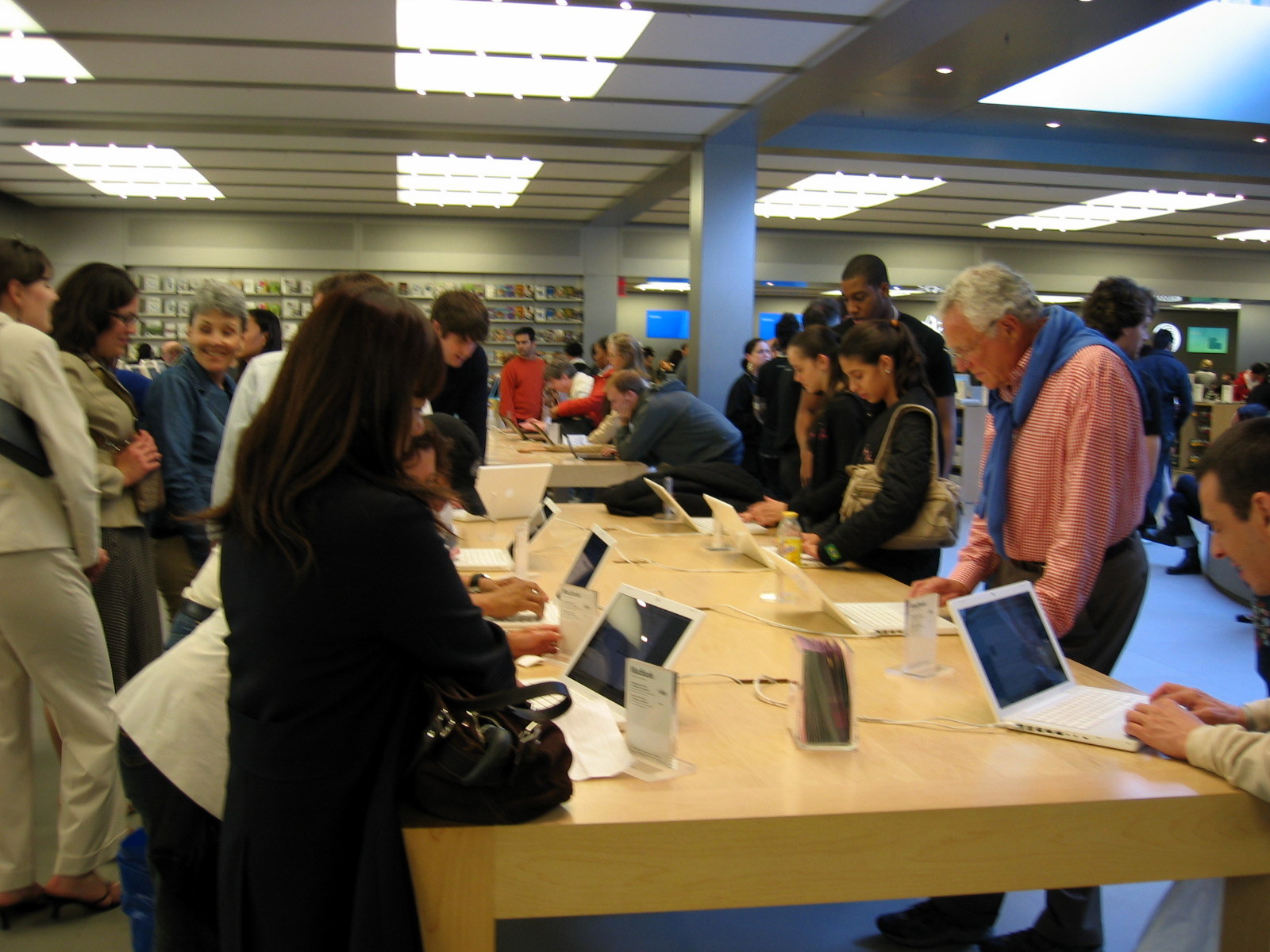
Applemania1Look for a cool Apple sign in any prominent location. Follow it and you will enter a glass clad store with a big trendy posters on the walls and series of Macs, iPods and other Apple products. But one special thing to notice there is it looks more like a hangout place or a cyber cafe than a store. What you will see is lots of people standing around surfing the Web and playing with Apple products and accessories.

Applemania3So what is Apple trying to do with these stores? Retail sales of iPods or Macs is certainly not the primary objective of these stores. Let alone primary, I think its not even the secondary objective (in fact when I was taking to a sales person about an iPod, she told me that I might want to think about buying it online, because then I can get a personal message engraved on the back of it). The primary objective is to maintain a cool brand image that Apple is well known for. Secondary objective is to let people use the Macs and other Apple products and let them know that there is another alternative available for them. And then if the store sells products and accessories, great!

Applemania2First of all, its worth admiring the artistic architecture of these stores. They look more like museums than stores. The one in New York on the fifth avenue is truely mesmerizing. Next thing to notice is the relaxed and calmed atmosphere in the stores. Customers are made to feel at home and they get close to home like experience while playing with the products. This is really a great strategy. People who are so used to using Personal Computers get exposed to Mac as an alternative and all the i list of products that work only with it.

Applemania5Another way Apple is marketing Mac and the bundled software at these stores is by arranging free training sessions (this is something I experienced in New York). Everyday they have guests from different fields varying from film editors talking about iMovies to web site designer giving a demo of how to use iWeb. By doing this, Apple is trying to create a thought process in minds of customers that anything cool they want to do on a computer can be done using a Mac.

Applemania7An interesting way to look at these Apple stores is to look at them as really expensive billboards on busy streets. Billboards that talk to the customers, let them get in and experience the products and educate them on how to use the products. Billboards that are updated regularly to expose the new products and create buzz about the forthcoming products.

Travel in metros, take a walk down any public park or just wander on busy streets, you will see one thing in common, every third person will be listening to an iPod. And this is not specific to a certain city, the same thing is happening everywhere. iPod has created a confidence in customers for Apple products. Now Apple is exposing the same customers to other products. If Apple gets the price equation straight for its products, it won’t be surprising to see them creating Applemania in other markets as well.

Spinning the Web with Spider-Man 3

Spider-Man 3 trailers aired by Sony Pictures were squarely out-numbered by Spider-Man 3 based promotions run by other companies. Tune in to any television channel and you will run into ads from Comcast, Trix and Kraft featuring Spider-Man 3. Turn on the radio and 7-Eleven spot will catch your attention. Go to Burger King or Walmart, and you will see the Spider-Man 3 promotions going on there. Walk down the Times Square, and you will see large Spider-Man sculptures in Virgin Store, Toys R Us and M&M World welcoming you in the stores.

Spider-Man 3 is a great example of network marketing at its very best. The movie that broke World box office record in its opening week partnered with about a dozen companies for promotion. Comcast, 7-Eleven, General Mills, Kraft, Walmart, Burger King, Toys R Us and others ran Spider-Man 3 advertisements. In fact, just General Mills, Kraft, Burger King and Comcast spent a cumilative of $100 million airing custom spots, many of which produced in-house at Sony Pictures with the help of the studio. Sony Pictures leveraged the brand name of Spider-Man extensively to make the most of the third addition of the Spidey movies.

This prompts a question that out of hundreds of movies coming out every year, why do advertisers jump onto a select few to spend millions? I think among other things, it depends on how well the movie is branded. The Spider-Man brand has a lot of good things going for it. Firstly, the brand got a solid establishment from the first two Spidey movies. Secondly, the universal appeal of the Spider-Man to everyone from a kid to an adult adds to the scope of branding. Another very important thing about the movie, which pulled in a lot of partners, is the creative concept of a simple person gaining extraordinary powers by donning a mask. This gives an “aspirational” value to the movie. The partner companies were able to target their customers by interpreting this value within their own World.

To create a successful partner network, the central entity should have enough meat that can be shared with all the partners. Thats so much true with Spider-Man 3. Spider-Man theme gives a lot of space for partners to evolve it and grow it in their own Worlds. Like Activision, another partner of Sony Pictures, is coming up with a Spider-Man 3 video game late in the year. Burger King developed a scratch-and-win game in which customer choose to reveal what’s behind their red-and-blue or black spidey, with a 50% chance of winning a prize everytime they play. The prize list includes some top prizes worth a million dollars making it even more attractive. Burger King also designed a kids meal promotion with 10 different Spider-Man theme toys to attract kids. Mass retailers like Walmart and Target have interesting activities related to Spider-Man World to attract customers to their stores. 

All these partnerships gave scope to the partners to attract customers with the help of the blockbuster movie. One deal that worked really well for Sony Pictures is the partnership with Comcast as a media partner. Sony studio lacking the TV network to promote the movie, hooked up with Comcast to do that for them. Comcast being the largest cable television provider in US came up with a special on-demand channel featuring exclusive Spider-Man 3 content and increasing the excitment for the movie. Along with this, it also kick-started the buzz for what is said to be the forth and final addition of the Spidey movies with an exclusive trailer. 

One of the most important things in order to do the integrated marketing correctly is the choice of right partners, and looking at these examples, Sony Pictures should be given full credit for doing a wonderful job in that space. All this brought together makes Spider-Man 3 a perfect example of integrated marketing efforts, and another example to show the overall power of integration!

The Times Square Magic

Neon lights, classic advertisements and mesmerizing retail stores – that’s Times Square in a nutshell. No wonder it’s the World’s biggest tourist attraction. I think there is no place in the World that brings together Advertising, Marketing and Technology in a way better than Times Square (Adscovery being an exception;-)). Some cool facts about the Times Square – It accounts for about 0.1% of New York City’s area, but accounts for 5% of city’s jobs and 10% of city’s economic output. The total economic output of $53 billion is more than the combined GDP of Bolivia and Panama.

With more than 40 million people visiting the place every year, what better place out there to advertise than Times Square? Annually aroung 1000+ hours of broadcasting are made from the Times Square. But in an industry where the cost is directly proportional to the number of eyeballs, marketers have to dig deep in there pockets to advertise on the Times Square. The CPMs here ranges from $2 to $5 (prime time TV CPMs are around $20). Advertisements are like the life blood of Times Square, both in terms of economic returns and making the place glow. The return of these advertisements for the marketers has grown exponentially with the advent of social networking and sharing websites like YouTube, Flickr and MySpace. People love to take pictures and videos of these advertisements and share it on these websites increasing the number of views by a large factor. 

Another major attraction on Times Square are the stores. The amount of creativity that goes in these stores is unparallel to any retailing experience in the World. From sugar rush stores of Hershey’s and M&M to kid’s paradise at Toys R Us to Virgin and MTV stores, Times Square has got it all. These stores do a great job of brand uplifting for these brands. Even if people don’t end up buying products at that perticular moment from a store, it leaves a lasting impression creating a strong brand equity. I won’t even classify these stores as just retail stores. They are infact highly interactive billboards. A billboard that communicates a message to the customers and invites them to experince the brand. Take for example the Virgin megastore. It has around 600 listening posts and 100 video posts in the store. Then there is the M&M World where literally walls and walls of M&M in different colors, sizes and shapes are there to entertain the “visitors”.

Times Square doesn’t end with billboards and stores. Add to the mix the theatres on the Broadway, skyscraping hotels, NASDAQ stock market and a couple of music shows in a year right there at the Square, and you can imagine the complete picture. Kudos to the City of New York for maintaining the place and all the marketers, advertisers and designers who put so much brain and energy to each and every square foot on the Times Square to make it a magical experience.

Brand New York City

New York City has a unique feel of its own. Be it the Financial District or the Time Square, the Grand Central or the Central Park, the Little Italy or the Chinatown, every part of the city adds a unique value to its brand. No city in the World comes close to the way New York markets itself. The fast moving Subways, the New York Stock Exchange, the Lady Liberty, the Broadways and the exotic shopping complexes, New York’s got it all to mesmerize anyone and everyone. 

When it comes to brand development, I think NYC does it in a way that can teach even the biggest corporations a lesson or two. The city exploits every channel to showcase itself as the place to be. It attracts everyone towards it. Seinfeld to Saturday Night Live creates a great scene to display the life in New York. The NYSE showcases the financial opportunities in the city, Broadway and studios call upon the artists, and what better place to attract the marketers and advertisers than the Times Square?

The city of New York has put great efforts in order to uplift the brand image. Taking drastic measures to reduce the crime in the city and spending millions to keep subways at par with the rail system anywhere in the World are just to name a couple. And speaking of brand development, how can someone not mention the I Love New York campaign? I think the campaign is far above and beyond any other campaign of its sorts. Now running for about 3 decades (it was started by the New York State Department of Economic Development in 1977), it promotes the metropolitian pride of the New York City.

The brand NYC also does a great job connecting with its customers. If you think of each visitor to the city as a customer, the city does a great job of involving them in it. Two days in the city and you no longer feel like an outsider. Stretch your legs down the crowded streets, catch a few subways or have a meal in one of those New York delis, you will instantaneously get a feel of being a part of the great city.  

People are the most important assets of any company. Same is true with New York. New Yorkers form the blood flowing in the veins of NYC. People living the fast paced life of New York, moving along with the city in every New York minute and welcoming outsiders to the city adds tremendous value to the brand.

The great thing about the New York City’s brand promotion is that it so beautifully hides the miseries of the city while creating the bright picture. Despite the traces of crime and poverty, like a perfect advertiser, New York keeps attracting more and more people towards itself and keep adding to the brand equity. Now what will be really exciting to do here is a brand extension of NYC to perhaps other cities in the US and around the Globe!